
ENGINEERING LEADERSHIP
Directional Clarity Is What Matters
Clear direction, decision rights, and context help a team move when complete information is out of reach.
Leadership rarely comes with complete information. There is always one more thing you could analyse, one more person you could speak to, or one more assumption you could validate.
Sometimes that extra work is necessary. But sometimes waiting for complete clarity becomes the problem.
Work slows down. Decisions get delayed. Teams start waiting for the leader to make every difficult call. I have come to believe that leaders do not need complete clarity.
They need directional clarity. People should understand where we are trying to go, what matters most, what constraints are real, and where they have the freedom to make decisions.
That is usually enough to move. And if the direction needs to change, we change it.
One of the easiest traps to fall into as a leader is becoming the person who resolves every ambiguity. Someone brings a problem. You make the call. Work moves.
It feels useful. But if every difficult decision needs me in the room, I have created a dependency.
The team may be moving, but it is still waiting for me. I would rather create an environment where people can make good decisions without needing me for every step.
For me, a few things help.
Start with the outcome, not the solution.
I try to be clear about what we are solving, why it matters and what constraints we have. But I do not want to prescribe every part of the solution.
If an engineer understands the problem well and comes back with a better approach than the one I had in mind, that is a good outcome. In reviews, I often come back to three questions:
What are we optimising for? What trade-off are we accepting?
What would make us change our mind? These questions usually lead to a better conversation than simply asking whether everyone agrees.
Ownership also needs authority.
Giving someone ownership of a problem is not enough. They need the information to make decisions. They need the authority to act. And they need to know when they should escalate.
If someone owns the outcome but needs approval for every meaningful decision, we have not really delegated ownership.
Turn direction into decision rights.
Illustrative example · Simplify an employee data-change journey.
- Outcome
- Remove duplicate entry and unclear status
- Constraints
- Protect access controls and required approvals
- Authority
- Choose the workflow and integration approach
- Escalation
- Raise policy changes or cross-team ownership gaps
- Revisit the decision
- Review if rework grows or new dependencies appear
Record the choice, the trade-off and the evidence that would make the team change course.
Sandeepan Sharma · sanndeepan.comDownload diagram (PNG)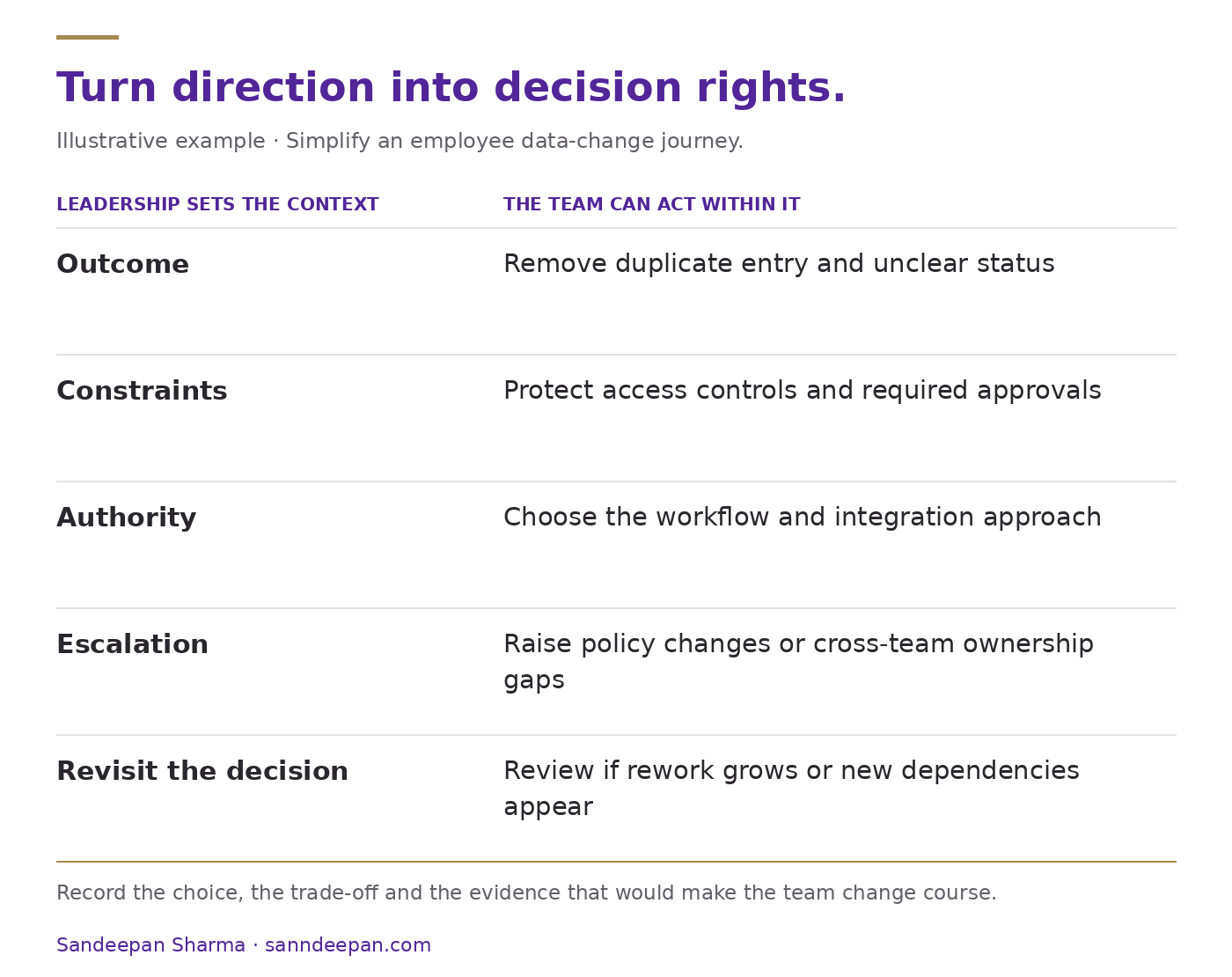
Check whether the direction is actually clear.
A simple test is this: Can people explain what matters most, what they can decide themselves, and when they need help?
If five people give five different answers, the problem is probably not execution. The direction is still unclear.
Capture why important decisions were made.
For bigger architecture or product decisions, I like to document a few things: The problem.
The options we considered. The decision we made.
The trade-off we accepted. And what would make us revisit the decision.
It does not need to become a ten-page document. A short record is usually enough.
It helps someone joining the conversation later understand not just what we decided, but why. And finally, clarity needs to survive reality.
Dependencies will slip. Priorities will change.
New information will appear. The goal is not to create a plan that never changes.
The goal is to give people enough context to know when they can adjust, when they should involve others, and when they need to escalate. Over time, this is what builds a team that can work through ambiguity without turning every open question into a leadership meeting.
For me, the real test of directional clarity is simple:
Can the team continue making good decisions when I am not in the room?
Ideas and perspectives are my own. Writing and editing assisted by AI.