
RETHINKING HR TECHNOLOGY · PART 3 OF 3
Design HR Services Around Intent, Not Interfaces
AI creates an opportunity to organise HR services around what people need, while keeping reliable workflows and human judgment at the centre.
The first two parts of this series were both about changing where we start. Start with the job, not the system.
Then focus on the moments where getting that job right really matters. Here's the next question, and it's the one where AI starts to change the model.
If we already know what someone is trying to do and which moment they're in, why do they still need to work out which HR system or team can help them?
For years we've designed HR technology around navigation. Which system do I use?
Which page do I open? Which form do I submit?
Which article do I read? Which team do I contact?
We've got better at all of it. Better portals, better search, better mobile, better knowledge bases, better workflows.
But the underlying assumption hasn't really moved:
The employee has to understand how the organisation is structured before they can get anything done.
AI challenges that assumption, and I think it will reshape HR service design far more than bolting a chatbot onto an existing portal.
Start with intent
Consider how a future HR service could respond to requests like these:
"I'm having a baby. What do I need to do?"
They shouldn't have to know whether the answer sits in Workday, ServiceNow, a benefits platform, a policy document or with an HR operations team. They're expressing intent.
The technology should help work out the rest. Same for all of these:
- "I've just become a manager."
- "I'm moving from India to the US."
- "I think my pay is wrong."
- "I want to hire someone."
- "I want to understand my compensation."
- "I'm planning to take extended leave."
None of those are system questions. They're human requests.
The job tells us what someone is trying to accomplish. The moment gives us the context around why that experience matters.
Intent has always been there.
What AI changes is our ability to understand that intent and coordinate what happens next across systems and services.
That is the opportunity.
Choose the right front door for the job
Today the front door is often a portal. A Workday home page, a ServiceNow employee centre, a knowledge site, a chatbot, a shared services queue.
For uncertain or multi-step needs, a conversation may be the most helpful front door. An employee can explain what is happening in their own words, and the service can clarify the request before suggesting a path.
For a straightforward leave balance or a standard data change, a clear form or deterministic workflow may be faster, easier to audit, and less error-prone. Conversational AI should help where ambiguity and cross-service navigation create real work; it should not replace a reliable form simply because it can.
That's a meaningful shift.
We stop expecting employees to navigate our technology and start asking our technology to navigate the organisation for them.
Workflows become services
HR technology has traditionally been organised around workflows. Job change. Leave request. Compensation change. Recruiting. Onboarding. Benefits enrolment.
Those workflows aren't going anywhere. But we can expose them differently.
Instead of expecting someone to understand the workflow, expose the service:
- Help me take parental leave.
- Help me relocate.
- Help me hire someone.
- Help me understand my pay.
- Help me become a manager.
Behind that request there may still be several applications, APIs, approvals, integrations, policies and business rules. The employee shouldn't have to know any of it.
The complexity belongs behind the service, not in front of it.
Where AI agents get interesting
The first wave of enterprise AI has mostly been about answering questions and finding information. Useful, but limited.
The next step is action. An agent can understand a request, gather what it needs, interact with systems, complete parts of a process, track progress, and pull a human in when judgement is required.
Take relocation again. Today the employee deals separately with mobility, payroll, HR, immigration, benefits, IT and finance, often repeating themselves at every stop.
In an agent-led model they start with one request.
In that model, an agent could identify the services involved, coordinate routine steps, surface decisions for the right person, and keep the employee informed. Any change to pay, benefits, immigration status, or sensitive employee records should have an explicit human approval boundary before the agent commits it, with the action and approver recorded.
That's the move from a pile of transactions to something closer to an orchestrated experience.
From navigation to intent.
Illustrative future service · “I’m moving countries.”
- Find the right portal and team
- Clarify the request and personal context
- Repeat details across teams
- Connect approved knowledge and required services
- Chase separate approvals
- Route consequential actions for human approval
- Piece together the status
- Track the journey and escalate exceptions
Reliable workflows, trusted data and human judgment remain underneath the experience.
Sandeepan Sharma · sanndeepan.comDownload diagram (PNG)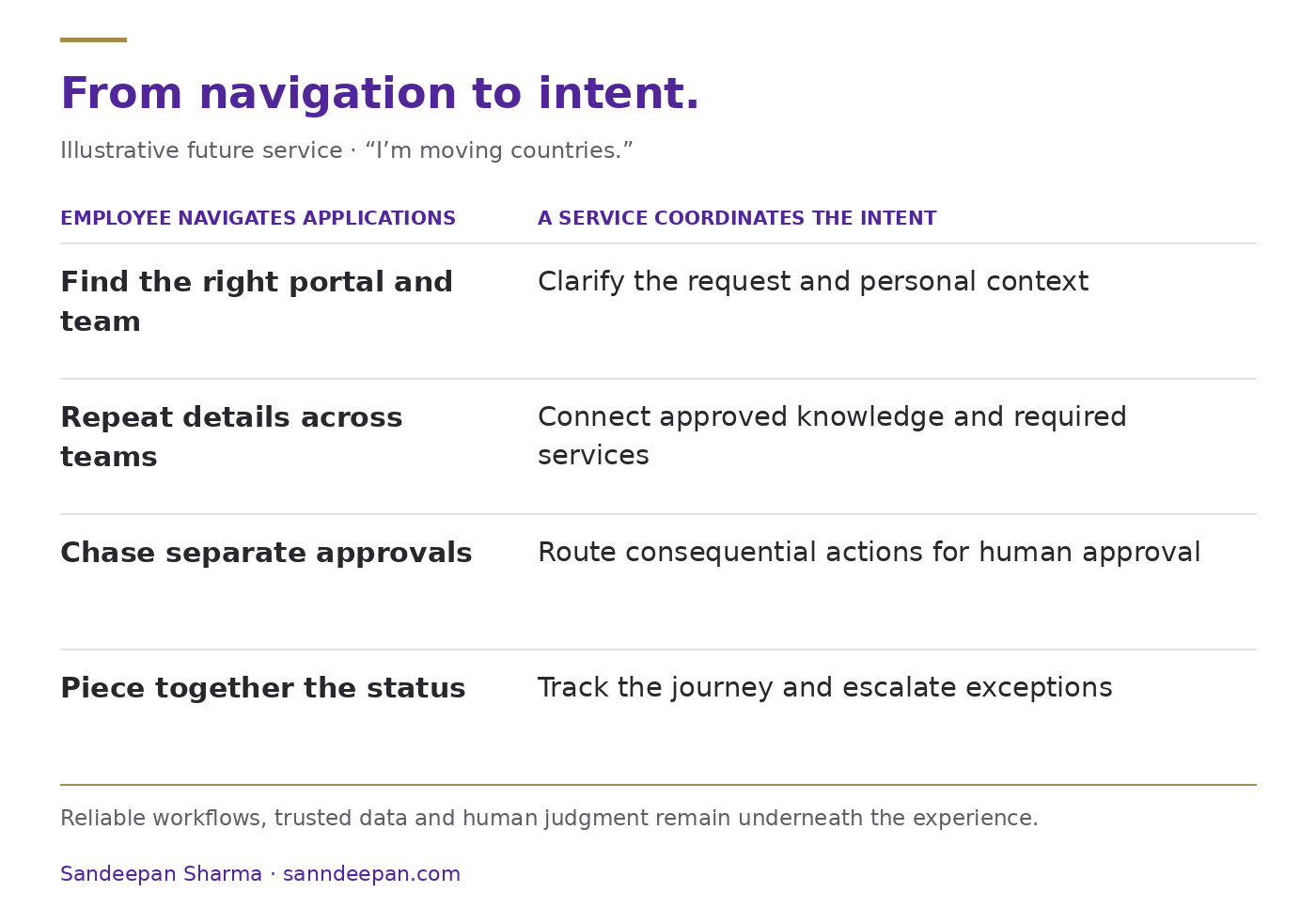
AI makes the foundations more important, not less
There's a catch, and it's a big one. AI can make HR technology feel simpler to employees.
But producing that simplicity takes stronger foundations underneath, not weaker ones. Trusted data.
Clear APIs. Reliable integrations.
Solid identity and security. Sensible access controls.
Clear process ownership. Well-defined policies.
Workflows you can actually observe. Good exception handling.
An agent can't reliably orchestrate a process that the organisation itself can't explain. If the employee data is unreliable, AI won't make it trustworthy.
If five teams interpret the same policy five different ways, a friendly interface on top won't fix that. It'll just give inconsistent answers faster.
AI doesn't make platform engineering less important.
It makes it more important.
The operating model may change too
This might be the bigger long-term shift. HR services are usually organised by function.
Payroll, benefits, talent, recruiting, mobility, HR operations. Technology teams tend to mirror those lines.
But intent doesn't respect our boundaries. "I'm moving countries" isn't simply a mobility request.
It touches immigration, payroll, tax, benefits, HR, finance, identity and IT. "I'm having a baby" isn't simply a leave request.
It touches benefits, pay, policy, manager actions, absence and return-to-work support. Agents can potentially coordinate across those boundaries much more naturally than traditional portals.
Over time, I think that pushes organisations to design services less around the internal shape of HR and more around the employee's intent and journey. That's a much bigger change than putting AI on top of an existing portal.
It changes the service model itself.
Human judgement still matters
None of this means everything should be automated. Some moments need empathy, judgement and confidentiality.
A difficult conversation. A sensitive employee relations case.
A complex accommodation. A hard return from leave.
The point isn't to take humans out of HR. It's to take the unnecessary effort out from around the human interaction.
Let AI gather information, explain an approved policy, coordinate routine work, and flag exceptions. Keep consequential decisions and actions under accountable human review. Then bring the right person in at the point where judgement is genuinely needed.
That's a better use of the technology, and a better use of the people.
From jobs to moments to intent
For years, enterprise technology asked people to learn our systems in order to get their work done. AI gives us a chance to reverse that.
The employee tells us what they're trying to accomplish. We understand the job.
We recognise the moment. We interpret the intent.
And the technology coordinates the services needed to get it done. The systems will still be there.
So will the workflows and the integrations. They'll just stop being the employee's problem.
That's the thread through this whole series: Start with the job, design around the moments that matter, and make intent easier to express without losing the discipline of structured workflows.
Not another layer of technology for people to learn.
Technology that makes the organisation easier to navigate.
Ideas and perspectives are my own. Writing and editing assisted by AI.