
RETHINKING HR TECHNOLOGY · PART 2 OF 3
Design Around the Moments That Matter
Some employee journeys carry more weight than others. That should shape where we invest in the experience.
In Part 1, I argued that HR technology should start with the job someone is trying to get done rather than the system they have to use. That raises an obvious follow-up.
Are all HR interactions equally important? I don't think they are.
Most transactions fade from memory. Certain moments do not.
The day they joined. The first time they became a manager. The promotion they'd worked toward for two years. The birth of a child. A move to another country. A difficult leave of absence. A problem with their pay. The day they decided to leave.
Those are the moments that matter, and they're one of the most practical ways I know to decide where to spend design effort.
Jobs tell you what. Moments tell you where to focus.
Jobs to Be Done tells you what someone is trying to accomplish. Moments That Matter tells you when the quality of that experience really counts.
That distinction is useful, because a large organisation might have hundreds of HR processes and there is no way to give all of them the same attention. A small number of experiences will shape how someone feels about the company far more than the rest.
Joining, getting paid correctly, changing roles, becoming a manager, taking parental leave, relocating, returning from leave, getting a difficult HR problem resolved, and leaving are all candidates. They will not have equal priority in every organisation.
If those moments are confusing or unreliable, people remember it for years. If they're simple and dependable, the technology more or less disappears.
That's usually a good sign.
Choose where to invest first
When resources are limited, I would score candidate journeys against four questions: how strongly does failure affect the employee, how often does the journey occur, what is the operational or compliance risk, and how much effort would improvement take? A rare but high-risk pay or leave failure may deserve attention ahead of a frequent low-stakes inconvenience. Then compare a manageable first improvement with the larger redesign it might unlock. The weights will depend on the organisation.
Start with the moment, not the module
Take parental leave. The technology conversation normally starts with the absence process.
What configuration do we need? Which approvals?
Which integrations have to run? All fair questions, and they all have to be answered.
But the employee is dealing with something much bigger than an absence transaction.
They want to understand their eligibility. Work out what happens to their pay. Check their benefits. Complete the right steps in the right order. Tell their manager. Provide documentation. Know what to hand over before they go. And understand what happens when they come back.
The employee sees one moment. The organisation sees six different processes.
A lot of the friction sits in that gap.
Relocation is the same story, only bigger. The employee thinks:
I'm moving from one country to another.
The organisation sees mobility, payroll, immigration, tax, benefits, HR operations, finance, identity and IT. Every one of those teams can do its part correctly, on time, to standard.
The experience can still feel like being passed around.
Parental leave is a journey.
Illustrative example · Follow the employee’s questions from planning to return.
- Plan the leave
- Uncertainty: eligibility, pay, benefits and next steps
- Prepare to leave
- Effort: documentation, approvals and handover
- During leave
- Consequences: correct pay and a clear route for help
- Return to work
- Confidence: return arrangements and manager support
Prioritise with impact, frequency, risk and effort. The weights depend on the organisation.
Sandeepan Sharma · sanndeepan.comDownload diagram (PNG)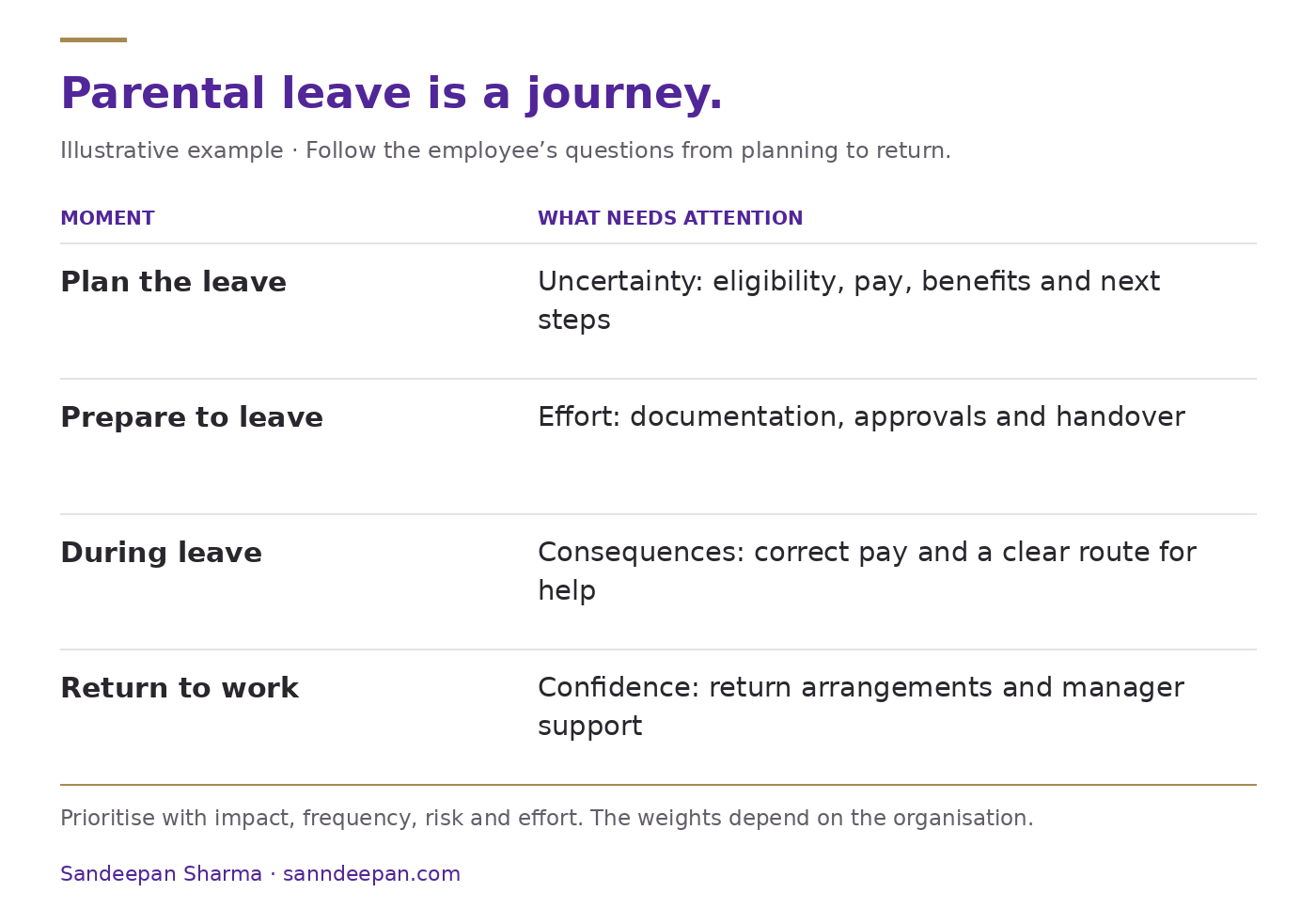
Follow the moment across boundaries
This is why I find the idea so useful in practice. Pick one important moment and map it end to end, from the employee's side rather than the system's.
Where do they start? What are they trying to understand?
What decisions do they have to make? Which teams get involved, and which systems?
Where do they wait? Where do they give us the same information twice?
Where does ownership go fuzzy? Where do they lose sight of what's happening?
And where are they most likely to give up and ask someone for help? Those questions surface problems no dashboard will show you.
Every integration can be green and every ticket inside SLA while the overall moment still feels difficult.
Measure the experience, not just the transaction
We're good at measuring operations. Availability. Integration success. Ticket volumes. SLA performance. Completion rates.
Keep all of it. But for the moments that matter, I'd add a second set of questions:
- How many steps did the employee have to complete?
- How many teams did they have to contact?
- How often did they give us information we already held?
- How long did they wait with no idea what was happening?
- How many exceptions needed someone to intervene manually?
- At the end, were they confident everything was actually done?
Those are the numbers that tell you whether you simplified anything.
Someone has to own the whole journey
This is where HR technology stops being just system configuration. A good moment depends on platforms, data, workflows, policies, integrations and support all working together.
Recruiting owns a piece. Payroll owns a piece.
HR operations owns a piece. Technology owns a piece.
Somebody still has to look across the whole thing. Otherwise every team optimises its own part and we quietly leave the employee to join up the experience themselves.
For me, that's one of the biggest opportunities in this space. Move from designing around modules to designing around experiences.
Move from asking:
Did the system complete the transaction?
to:
Did the employee get through an important moment with less effort, less uncertainty and more confidence?
And that leads to Part 3. Even when we design around jobs and moments, today's employee usually still has to work out where to go.
Which portal. Which system.
Which form. Which article.
Which HR team. AI starts to challenge that.
What happens when people don't need to understand our systems at all, and can simply tell us what they need? That moves us from designing around interfaces to designing around intent.
Start with the job. Design around the moments that matter. Then make it easier for people to say what they need.
Ideas and perspectives are my own. Writing and editing assisted by AI.